Buying your first sailing yacht: a checklist
How you will sail, what size to buy, what to inspect yourself before paying for a survey, and how to plan your first season. A practical checklist for first-time sailing yacht buyers.
By Yachtxchange Editorial · February 3, 2026 · 5 min read
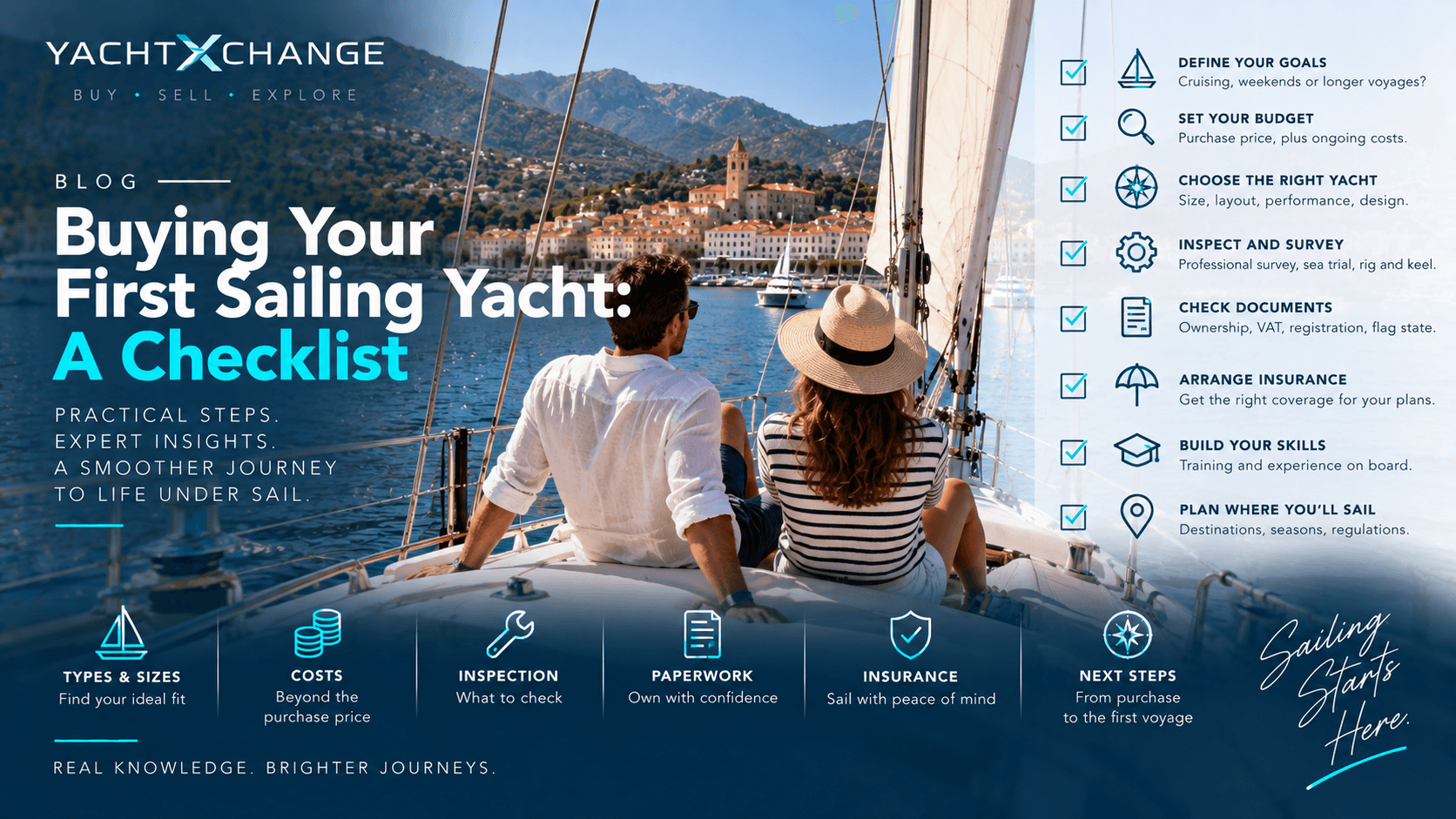
Buying your first sailing yacht is exciting, and that is exactly the problem. It is easy to fall for a boat on a sunny afternoon and only later discover that she is too big to handle with two people, too old to insure easily, or too expensive to keep. The buyers who end up happiest are the ones who decided how they would use the boat before they started looking.
This checklist takes you through those decisions in order, from how you will sail to what to inspect yourself before you pay a professional, and how to approach your first season.
Decide how you will use the boat
Start here, because every other decision follows from it.
- Day sailing. Short trips from a home port, back for the night. Speed, simple handling and a good cockpit matter more than cabins and tankage.
- Coastal cruising. Several days or weeks moving between harbours and anchorages. You need comfortable berths, a usable galley, enough water and fuel, reliable ground tackle and some way of keeping batteries charged.
- Offshore passages. Nights at sea, far from shelter. This asks much more of the boat and the crew: a strong rig, a secure layout for moving around at sea, sea berths, and gear that can be fixed on board.
Be honest. Most first-time owners mainly sail coastal waters, and a boat designed for ocean crossings can be heavier, slower and more expensive than they need.
Size: bigger is not better for a first boat
A larger boat costs more in every way: berthing, antifouling, sails, insurance, maintenance. Loads on sheets, halyards and anchors grow quickly with size, and a big boat is harder to handle in a tight marina with a short-handed crew. Many experienced sailors would advise a first-time owner to buy the smallest boat that fits how they will really use it. You will sail her more, learn faster, and lose less when you move on.
Monohull or catamaran
Catamarans offer space and stability at anchor; monohulls usually sail better upwind, cost less to berth and have one engine to maintain. Our guide to catamaran or monohull sets out the trade-offs in detail. If you are unsure, charter one of each before you buy.
Age and build quality
An older yacht from a respected builder, well maintained, can be a better buy than a newer boat that has been neglected. Age alone tells you little. What matters is the original build quality, the maintenance history and what has been replaced. Ask when the standing rigging, sails, engine and electrics were last renewed, and ask for receipts. Be aware that some insurers and marinas apply extra conditions to older boats, so check before you commit.
Layout and handling for a short-handed crew
Most first boats are sailed by two people, sometimes one. Look at the boat as a working platform, not just a living space.
- Can the helm reach the mainsheet and the primary winches?
- Are the lines led back to the cockpit, and are there enough winches and clutches?
- Is there a simple reefing system you can use without going forward?
- Are there good handholds below and a clear route along the side decks?
- Is the anchor windlass operable from the bow and, ideally, the helm?
- Can one person step ashore safely when berthing?
Budget for purchase and the first year
Your budget is not the asking price. Set aside money for the survey, any repairs the survey finds, registration, insurance, a berth, and the gear the boat is missing: safety equipment, an updated chart plotter, a new set of sails or a fresh service. Many buyers spend noticeably more than they expected in the first year. Our article on the true cost of owning a yacht walks through the running costs.
What to inspect yourself before paying for a survey
A professional survey is essential, but you can rule out many boats yourself first. On a viewing, look at:
- Deck hardware and chainplates. Look for cracks in the gelcoat around fittings, rust stains, and signs of water leaking below, such as stained headlinings or soft deck areas when you press with your foot.
- Rig. Look along the mast for straightness, and check for corrosion at fittings and cracked swage terminals. Ask the age of the standing rigging.
- Sails. Unroll or hoist them if you can. Check for worn stitching, stretched cloth and UV damage on the sacrificial strip of a furling sail.
- Keel and rudder. If the boat is ashore, look for cracks or weeping at the keel-to-hull joint and check for play in the rudder. Ask whether the keel has ever been dropped or the boat grounded hard.
- Engine. Look for oil leaks, rust, a clean and dry bilge beneath it, and a service record. Ask to start it from cold.
- Osmosis and moisture. Look for blisters on the underwater hull of a fibreglass boat. Only a surveyor's moisture meter will tell you more, but obvious blistering is worth noting.
- Electrics. A tidy panel and labelled wiring are a good sign. A tangle of added cables is not.
- Documents. Ask for proof of ownership, registration, evidence of VAT status where relevant, and builder and conformity documents. If the paperwork is incomplete, find out why before you go further.
If a boat fails several of these checks, save your survey fee for the next one.
Survey and sea trial
When you have found the right boat, make your offer subject to a satisfactory survey and sea trial. Choose an independent surveyor with experience of sailing yachts; our guide on how to find a marine surveyor explains what to look for. Ask whether the survey includes the rig, or whether a specialist rigger should check it. On the sea trial, hoist every sail, use every winch and run the engine under load. Be there for both, and ask questions.
Qualifications, training and insurance
Requirements for qualifications vary by country, by the flag of the boat and by where you sail, so check what applies to you with the relevant national authority. Insurers may also ask about your experience. Even where no certificate is required, a recognised sailing course, a radio operator's licence and first aid training will make you safer and more confident. Ask for insurance quotes before you buy: the cost and conditions can depend on the boat's age, value, cruising area and your experience.
Advice for your first season
- Start in familiar, sheltered waters and build up to longer passages.
- Practise berthing and anchoring on calm days until they feel routine.
- Learn the boat's systems: where every seacock is, how to bleed the engine fuel system, how the batteries are charged.
- Keep a log of maintenance and faults. It will help you, and it will help when you sell.
- Sail with experienced friends or hire an instructor for a few days on your own boat.
Start your search
Browse sailing yachts for sale on Yachtxchange and compare boats by size, age and location. When you have a shortlist, take this checklist with you to every viewing.
This article is general information and does not replace professional advice, recognised training or good seamanship.