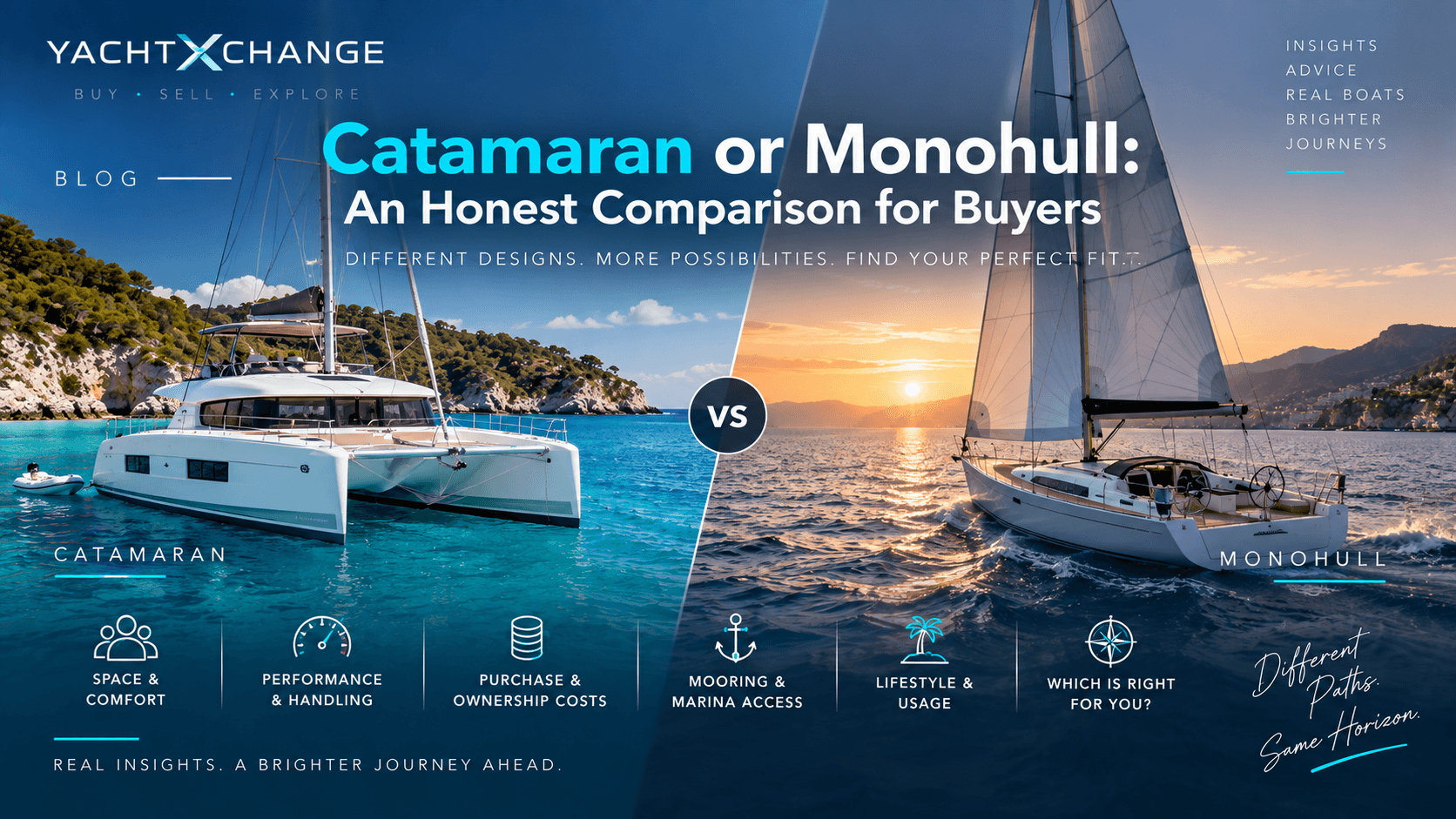
Catamaran or monohull: an honest comparison for buyers
Space and stability at anchor, or feel and windward ability under sail? A practical comparison of catamarans and monohulls, without the myths, to help you choose the right boat for how you will really use it.
By Yachtxchange Editorial · December 19, 2025 · 6 min read
Few questions divide sailors as reliably as this one. Owners of each type tend to defend their choice with conviction, and much of what you hear in marina bars is half true at best. For a buyer, the right answer depends less on which type is "better" and more on how you will use the boat: where you will cruise, with whom, for how long at a time, and what you will do with the boat when you sell it.
This guide sets out the real differences, the trade-offs on each side, and the kind of owner each type tends to suit.
Living space and life at anchor
Catamarans win on space. On a similar length, a catamaran offers far more usable living area: a large saloon at deck level, a cockpit that connects to it, and cabins in each hull that give couples or families real privacy. For many buyers, the view from the saloon alone settles the question.
Stability at anchor is the other big advantage. A catamaran does not roll the way a monohull does in a swell. Drinks stay on the table, sleep is easier, and guests who are not natural sailors are far more comfortable. If most of your time will be spent at anchor, with friends or family aboard, this matters more than any performance figure.
A monohull's interior is lower and more enclosed. Some people find that cosy and secure; others find it dark. A good monohull layout uses its volume well, but it cannot match the open plan of a catamaran.
Motion under way
The two types move differently, and it is worth trying both before you decide.
- A monohull heels. It leans to the wind and then settles into a steady angle. The motion is often described as more natural and predictable, and many sailors find it easier on the stomach in a seaway.
- A catamaran stays upright but has a quicker, sometimes jerkier motion, especially in short, steep seas. Waves can also strike the underside of the bridgedeck between the hulls, which is noisy and uncomfortable. Bridgedeck clearance is an important point to check on any catamaran you consider.
Neither motion suits everyone. A sea trial in real conditions, not a flat-calm afternoon, is the only reliable test.
Performance on different points of sail
Upwind, a good monohull usually has the edge. Its keel lets it point higher and hold its course to windward more efficiently. Many cruising catamarans, especially heavily loaded charter-style models, sail upwind less well and may need to tack through wider angles or use the engines.
Reaching and downwind, catamarans are often faster. With no ballast keel and a light, wide platform, a well-designed catamaran can cover long distances quickly on a reach or a broad run, and do so without rolling.
Weight matters more on a catamaran than on a monohull. Every extra tank, generator and box of stores costs performance. A catamaran that is loaded like a floating apartment will sail like one.
Shallow draft and beaching
Most cruising catamarans draw noticeably less than a monohull of similar length. That opens up anchorages closer to the beach, shallow lagoons and harbours that a deep-keeled monohull must avoid. Some catamarans with small fixed keels can be dried out on a suitable beach, which helps with inspections and simple bottom work in tidal waters. Check the builder's guidance before you try it: not every design is built for it.
Two engines and redundancy
Most catamarans have one engine in each hull. With widely spaced propellers, a catamaran can turn almost on the spot, which makes close-quarters handling easier for many owners. If one engine fails, you can usually still motor home on the other.
The other side is cost: two engines mean twice the servicing, two saildrives or shaft systems, and twice the parts to replace over time. Factor that into your running budget.
Berthing costs
Many marinas charge multihulls more than monohulls of the same length, often by applying a surcharge or by pricing on length and beam. Some marinas also have fewer berths wide enough for a catamaran, which can make it harder to find a place in busy areas during peak season. Before you buy, ask the marinas where you plan to keep the boat for their multihull rates and availability. Our marinas directory is a good starting point.
Heavy weather and seaworthiness
This is where myths are most common, so it is worth being careful.
- A monohull with a ballast keel is designed to right itself after a knockdown. However, it can be rolled heavily and, if it is holed, the ballast can make it sink.
- A catamaran does not rely on ballast for stability. It resists heeling strongly, but if it is flipped by wind and waves, it will not right itself. Many catamarans have buoyancy built into the hulls and are designed to stay afloat even when damaged or inverted.
Both types cross oceans safely every year. What matters most is the design and build quality of the specific boat, its condition, its sail plan, and the skipper's judgement. On a catamaran, that means reducing sail early, because the boat does not warn you by heeling. On a monohull, it means respecting the limits of crew strength and comfort in a long blow. Good training and conservative seamanship matter more than the number of hulls.
Resale and the charter market
Catamarans have become very popular, especially in the charter fleets of the Mediterranean and the Caribbean. That brings two effects for buyers.
- Demand is strong, which has helped many catamarans hold their value well.
- Many used catamarans are ex-charter boats. They can be good value, but they have usually worked hard. A thorough survey, including the engines, rigging, bridgedeck and hull-to-deck joints, is essential.
Well-kept monohulls from respected builders also hold their value, and the larger market of buyers can make them easier to sell in some regions.
Power catamarans: a separate category
Power catamarans are not simply sailing catamarans without a mast. They combine the space and stability of two hulls with the range and fuel efficiency that a light, narrow-hulled design can offer at moderate speeds. For owners who want a motor yacht with more living space and less rolling at anchor, they deserve a look. Compare them with traditional motor yachts on range, fuel use at your planned cruising speed, and berthing costs.
Which suits which owner
A catamaran often suits you if:
- You spend most of your time at anchor or in coastal cruising.
- You sail with family, guests or people who suffer from seasickness on a heeling boat.
- You value space, privacy and shallow anchorages over pointing ability.
- You are thinking of chartering the boat at some point.
A monohull often suits you if:
- You enjoy the feel of sailing and want good upwind performance.
- You plan long passages where a predictable motion matters.
- You want lower berthing costs and a wider choice of marina berths.
- You prefer simpler systems, with one engine to maintain.
Many buyers end up somewhere in between. If you are unsure, charter one of each type for a week in the waters you plan to cruise. It is the cheapest way to avoid an expensive mistake.
Start your search
Browse catamarans for sale and sailing yachts on Yachtxchange to compare layouts, ages and prices side by side. When you have a shortlist, an independent survey is the best money you will spend: our directory of marine surveyors helps you find one near the boat.
This article is general information and does not replace professional advice, training or good seamanship.