Cruising the Greek islands: Ionian or Aegean, the meltemi, harbours and paperwork
Greece has two very different cruising grounds. A practical guide to choosing between the gentle Ionian and the windy Aegean, planning around the meltemi, mooring stern-to on your own anchor and arranging the paperwork.
By Yachtxchange Editorial · October 13, 2025 · 6 min read
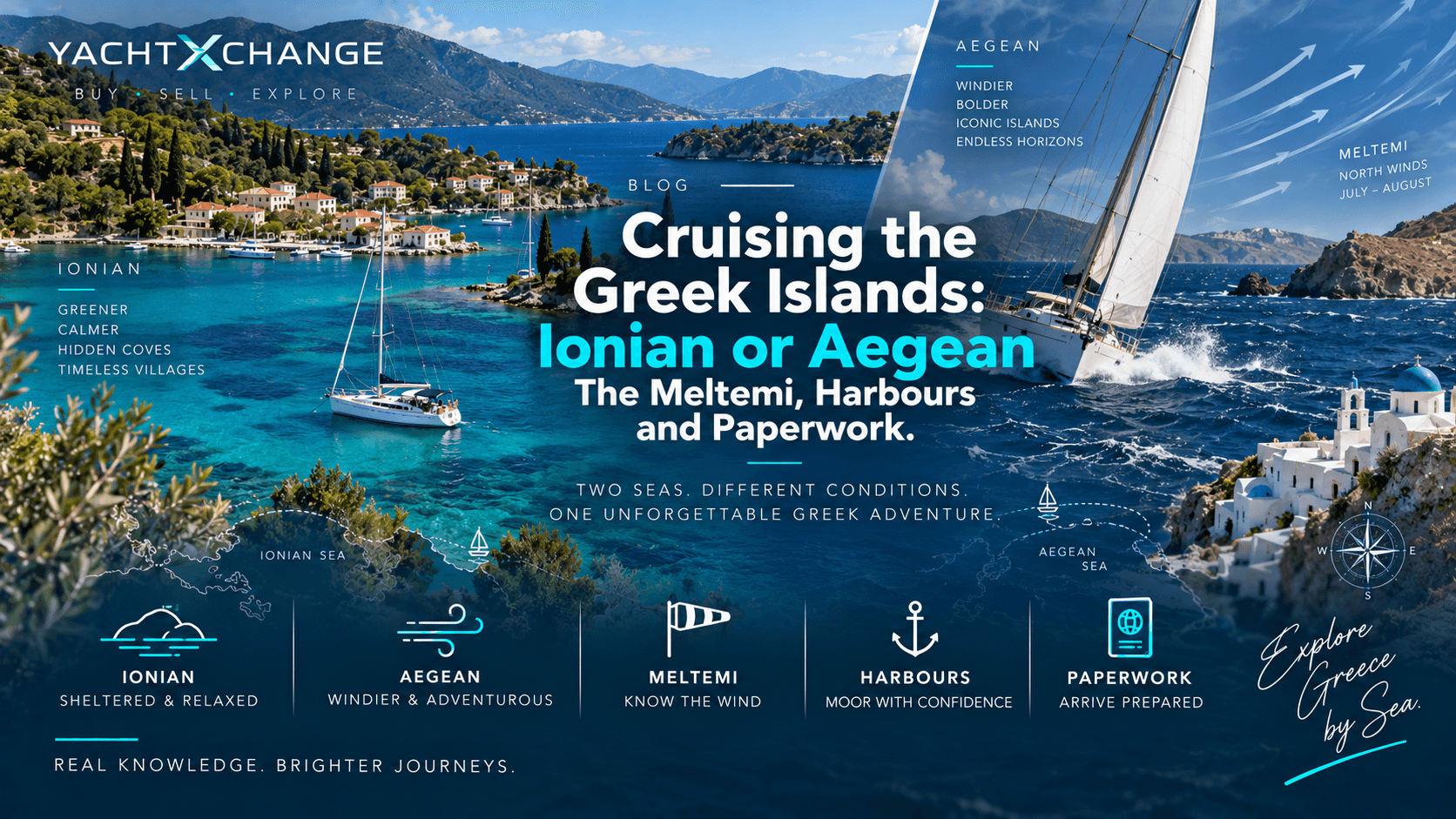
Greece has thousands of islands spread across two seas with very different characters. A week in the sheltered Ionian and a week in the Cyclades can feel like two different sports, so choosing the right area for your boat, your crew and the month you sail is the most important decision you will make.
This guide covers the main areas, the meltemi, where to stop each night, mooring stern-to with your own anchor, and the formalities to arrange first.
Ionian or Aegean
The Ionian. Off the west coast, from Corfu south to Zakynthos, the islands are green, the passages short and the inland sea between Lefkada, Meganisi, Ithaca and the mainland well protected. Summer usually brings calm mornings and a north-westerly afternoon breeze. It is the easiest place in Greece for a first cruise or a family crew.
The Aegean. East of the mainland, the Aegean is larger, more open and windier:
- The Saronic Gulf. Aegina, Poros, Hydra and Spetses, close to Athens and fairly sheltered. A good first week in the Aegean.
- The Cyclades. Kea, Syros, Paros, Naxos, Mykonos, Milos and many more. Longer open-water passages and the full force of the meltemi in high summer. Best for experienced crews and well-found boats.
- The Dodecanese. Rhodes, Symi, Kos, Leros, Patmos and their neighbours, close to the Turkish coast. The meltemi is often a little less severe than in the central Cyclades, but it can still be strong.
- The Sporades. Skiathos, Skopelos and Alonissos, north of Evia. Wooded islands and a national marine park around Alonissos with its own rules on access, anchoring and fishing.
The meltemi and how to plan around it
The meltemi is the seasonal northerly wind of the Aegean. It blows most often and most strongly from roughly July to the end of August, though it can appear from May to October. In the northern Aegean it tends to come from the north or north-east; in the Cyclades it is usually northerly, and towards the Dodecanese it often turns north-westerly.
It can blow at force 6 to 7 for several days, sometimes more, with steep seas between islands and strong gusts in the lee of high ground. It often eases at night, but not always.
How experienced skippers plan for it:
- Go north and east early in the week, so that the return legs are downwind or on a reach.
- Sail early in the day and arrive before the afternoon peak.
- Keep one or two spare days for waiting in harbour.
- Choose harbours sheltered from the north, and watch for ferry wash in island ports.
- Reef early and check the forecast at least twice a day.
If the meltemi is too much for your crew, the Ionian, the Saronic Gulf or the shoulder months are sensible alternatives.
Harbours, town quays and anchorages
Marinas. Greece has fewer marinas than Italy or Croatia, concentrated around Athens, Lefkada, Corfu and Rhodes. They are useful for crew changes, repairs and winter storage, but most island nights are spent elsewhere.
Town quays. The classic Greek night: stern-to on a harbour quay, a few steps from the tavernas. Some quays have water and power, others nothing, and a small port fee is usually charged. Lazy lines are rare outside marinas, so you will normally use your own anchor.
Anchorages. Anchoring is free in most places. Holding is often good on sand, though weed and rock are common, and in tight coves crews take a line ashore. Respect seagrass and local restrictions.
Mooring stern-to with your own anchor
This is the skill to practise before you arrive.
- Prepare first. Fenders on both sides, two stern lines ready, the anchor free to drop, and a crew member at the bow with agreed hand signals.
- Choose your spot and note where neighbouring anchors are likely to lie, usually straight out from each boat.
- Line up three to four boat lengths out, or further in deep water, and drop the anchor while going slowly and straight astern.
- Pay out chain steadily as you reverse. Too little and the anchor will not hold; too much slack and the bow will swing.
- Snub the chain a boat length or two from the quay to set the anchor, then continue slowly.
- Pass the stern lines ashore and tighten the chain to hold the boat off the quay.
Crossed anchors are part of life in busy harbours. If you lift someone else's chain when leaving, pass a line under it, hold it, free your anchor and release the line.
Formalities for visiting yachts
Greek rules have changed several times in recent years, so treat this as a checklist, not a definitive guide.
- Cruising tax. Greece charges a cruising tax on leisure vessels above a minimum length that cruise in Greek waters, paid in advance through an online system. The amount depends on the boat's length and the period covered.
- Vessel documents. Depending on the flag and how the boat is used, some vessels need a transit log or a DEKPA (a document for private pleasure craft) issued by the port authorities. Requirements differ between EU and non-EU flagged boats.
- Port of entry. Boats arriving from outside the Schengen area, for example from Turkey to the Dodecanese, must first go to a designated port of entry for passport, customs and port police formalities.
- On board. Expect to show registration, insurance, the skipper's qualification, a radio licence and a crew list. The port police check papers regularly.
Confirm the current requirements with the Hellenic Coast Guard (port police) or an experienced local agent before you leave, and keep all receipts on board.
Season
June and September suit most crews: warm water, space in the harbours and usually less wind. July and August are hot and busy, with the meltemi at its strongest. May and October are quieter still, with less settled weather and some services closed.
A one-week route in the Ionian, from Lefkada
- Lefkada to Meganisi. A short first leg to a bay on the north coast.
- Meganisi to Kalamos. A quiet island with a small harbour.
- Kalamos to Kastos. A short hop to a tiny, peaceful harbour.
- Kastos to Ithaca. To Kioni or Vathy, both well sheltered.
- Ithaca to Fiskardo (Kefalonia). Popular; arrive early in season.
- Fiskardo to Sivota (Lefkada). A sheltered inlet on the south coast.
- Sivota back to Lefkada. Via the bays around Nidri and Vlicho.
A one-week route in the Cyclades, from Lavrio
Lavrio, south-east of Athens, is a common base for the Cyclades. Adjust this route to the meltemi each day.
- Lavrio to Kea. A short crossing to Vourkari or Korissia.
- Kea to Syros. A longer leg to Ermoupoli or Finikas.
- Syros to Paros. To Naoussa, or to Antiparos.
- A day on Paros or Antiparos. Your weather day.
- Paros to Serifos. West to Livadi, often a reach in a northerly.
- Serifos to Kythnos. To Loutra or a west-coast bay.
- Kythnos to Lavrio. Via Kea if you need to shorten the leg.
Start your search
If you would like to cruise Greece in your own boat, browse the yachts for sale in Greece on Yachtxchange, many of them already based in Greek waters. The Greek marinas directory helps you plan crew changes, repairs and a winter berth, and our guide to navigating the Mediterranean covers the wider passage planning.
This guide is general information. It does not replace official charts, pilot books, notices to mariners, local regulations or good seamanship. Taxes and documentation rules change; confirm them with the Greek port authorities before you sail.