Cruising the French Riviera and Corsica: winds, berths, anchoring rules and routes
From Saint-Tropez to Menton, the Îles d'Hyères and the wild west coast of Corsica. A practical guide to the mistral and libeccio, finding a berth in high season, France's anchoring rules and two sample routes.
By Yachtxchange Editorial · December 4, 2025 · 6 min read
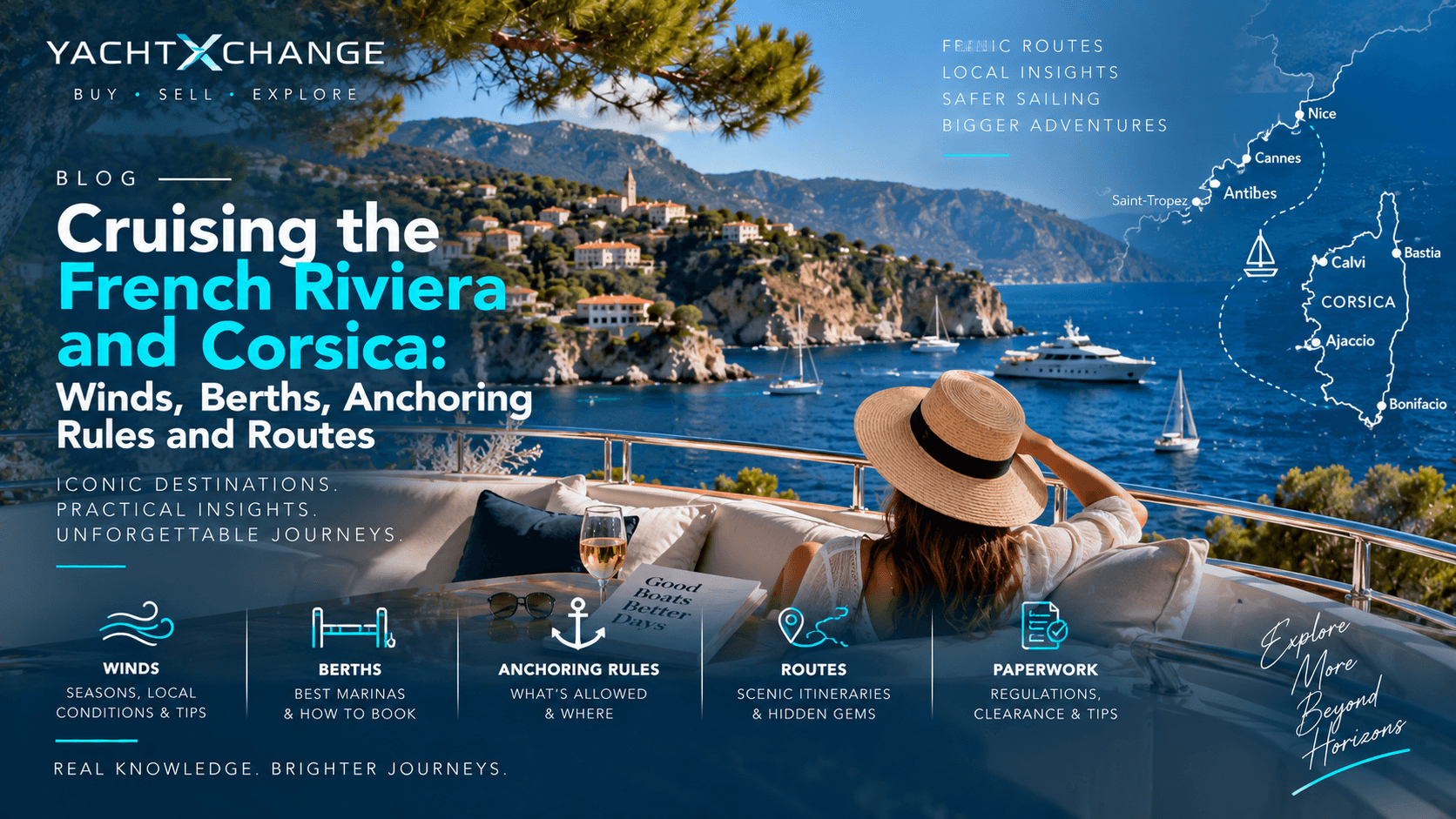
The French Riviera is one of the most famous yachting coasts in the world, and Corsica, a long day's passage to the south-east, is one of the wildest islands in the Mediterranean. Together they offer a rare combination: glamorous harbour towns, protected islands and national parks, and granite coves where you can still find space in summer.
They also demand planning: summer berths are scarce, anchoring rules are strict and the mistral can turn a pleasant crossing into a hard one. This guide covers the areas, the winds, where to stop and the rules to check.
The Côte d'Azur, from Saint-Tropez to Menton
Saint-Tropez and its gulf. The town harbour is famous and very busy in summer. The gulf offers anchorages and marinas such as Port Grimaud and Sainte-Maxime, and the bays towards Cavalaire to the south-west.
Cannes and the Îles de Lérins. Cannes has several harbours. Just offshore, the channel between Sainte-Marguerite and Saint-Honorat is one of the most popular anchorages on the coast, and rules there are strict.
Antibes, Nice and Villefranche. Antibes is home to one of the Mediterranean's best-known superyacht harbours. Villefranche-sur-Mer has a large, deep bay that is a favourite anchorage between Nice and Cap Ferrat, with Beaulieu-sur-Mer and Saint-Jean-Cap-Ferrat close by.
Monaco and Menton. Monaco is a separate country between Nice and Menton, with its own formalities and two harbours. Berths are hard to find in summer and almost impossible during major events. Menton, the last French town before Italy, has two harbours and a quieter feel.
The Îles d'Hyères and Port-Cros National Park
West of Saint-Tropez, the Îles d'Hyères are some of the most beautiful islands in southern France.
- Porquerolles. The largest island, with a harbour, beaches and sheltered anchorages along the north coast.
- Port-Cros. A small, hilly island at the heart of Port-Cros National Park, one of France's first national parks. The park has rules on anchoring, mooring, speed, fishing and diving, and uses mooring buoys in some bays to protect the seabed.
- Le Levant. Much of the island is a military zone with restricted access to the surrounding waters. Check the charts and notices for current limits.
The park's rules also cover parts of Porquerolles and the surrounding sea. Read them before you arrive and ask the park office if you are unsure.
Corsica: the west coast, Bonifacio and the Lavezzi
The crossing from the Riviera to Calvi is around 90 nautical miles, a long day or an overnight passage. Wait for a good forecast: this stretch of open sea can be rough when the mistral blows.
Calvi to Girolata. Calvi has a citadel and a large harbour. To the south, the Scandola nature reserve protects spectacular red cliffs; access and anchoring are restricted within the reserve. Girolata, nearby, is a small bay with mooring buoys and no road access.
The Gulf of Porto to Ajaccio. Deep gulfs and steep mountains, with anchorages that are beautiful in settled weather and exposed to the west. Ajaccio, the island's capital, has good facilities.
Propriano to Bonifacio. The Gulf of Valinco leads south to Bonifacio, whose harbour lies at the end of a narrow inlet under limestone cliffs. It is one of the most memorable arrivals in the Mediterranean.
The Lavezzi and the Strait of Bonifacio. The Lavezzi islands, east of Bonifacio, are part of a marine nature reserve with granite rocks, clear water and strict rules. The strait between Corsica and Sardinia is known for strong winds funnelled between the two islands, and it carries commercial traffic. Treat it with respect.
The winds: mistral and libeccio
- Mistral. A cold, dry north-westerly that funnels down the Rhône valley and spreads east. It often comes with a clear sky, can blow strongly for several days and builds a steep sea quickly. It is felt hard around Hyères, on the crossing to Corsica and in the Strait of Bonifacio. The coast further east is often more sheltered, but not always.
- Libeccio. A south-westerly that can make the gulfs of western Corsica uncomfortable or dangerous, with strong gusts in the north of the island.
- Summer thunderstorms can bring sudden squalls near the mountains.
Check the Météo-France forecasts at least twice a day and plan an alternative for every night.
Marina berths in high season
In July and August, visitor berths on the Côte d'Azur are very limited, especially for larger yachts, and harbours such as Saint-Tropez, Antibes and Monaco are often full.
- Book early, often months ahead for July and August.
- Confirm by phone or email and keep the confirmation.
- Call on VHF before arriving and wait for instructions outside the harbour.
- Have a second plan, such as a quieter harbour nearby or a sheltered anchorage.
- Expect higher prices in peak weeks and during major events.
Corsica is easier, but Bonifacio, Calvi and Ajaccio fill up in August too.
Anchoring rules and Posidonia protection
France strictly protects its Posidonia seagrass meadows, which shelter fish and are badly damaged by anchors and chains.
- Prefectoral rules. The maritime prefecture for the Mediterranean issues local orders that regulate anchoring along the coast. In many areas, yachts above a certain size are no longer allowed to anchor on Posidonia, and must use designated anchoring zones or buoys.
- Smaller boats should also anchor on sand. Posidonia shows as dark patches on the seabed; sand is light.
- Protected areas such as Port-Cros, Scandola and the Lavezzi have their own additional rules.
- Close to the shore, speed limits apply and swimming zones are marked with buoys. Keep well clear of them.
The rules depend on the area and your boat's size, and they change. Check the current orders with the maritime prefecture or the harbour office, and use up-to-date charts that show seagrass and restricted zones. Fines can be significant.
Formalities
The right paperwork depends on your boat's flag, VAT status and where you arrive from. Monaco is not part of the European Union, although there is no border control with France, so check whether your boat's status raises any questions before you move between the two. Expect to carry registration, insurance, the skipper's qualification and a radio licence. If you arrive from outside the Schengen area or the EU, clear in at an appropriate port. Confirm the details with French customs or an experienced agent.
Two sample routes
A week on the Riviera, from Antibes
- Antibes to the Îles de Lérins, a short first leg.
- Lérins to Saint-Tropez, or a bay in the gulf.
- Saint-Tropez to Porquerolles.
- A day around Port-Cros and Porquerolles.
- Porquerolles back east to Cavalaire or Le Lavandou.
- A longer leg to Villefranche-sur-Mer.
- Villefranche to Monaco or Menton, then back to Antibes.
A week in southern Corsica, from Ajaccio
- Ajaccio to the Gulf of Valinco and Propriano.
- Valinco to Bonifacio.
- Bonifacio to the Lavezzi for the day, then a sheltered anchorage for the night.
- A day in the Strait if the wind allows, or a rest day in Bonifacio.
- Bonifacio back north to the Gulf of Valinco.
- Valinco to the islands at the entrance of the Gulf of Ajaccio.
- Back to Ajaccio.
Start your search
If this coast makes you want a boat of your own, browse the yachts for sale in France on Yachtxchange, and use the marinas directory to plan where she will be based. For wider passage planning, read our guide to navigating the Mediterranean, and if you plan to continue south-east, our guide to coastal cruising in Italy.
This guide is general information. It does not replace official charts, pilot books, notices to mariners, local regulations or good seamanship. Anchoring rules and formalities change; confirm them with the French authorities before you sail.