Coastal cruising in Croatia: regions, winds, berths and paperwork
Over a thousand islands, short hops and clear water. A practical guide to cruising Croatia: where to go, how the bora and jugo behave, where to stop for the night and what to arrange on arrival.
By Yachtxchange Editorial · January 29, 2026 · 6 min read
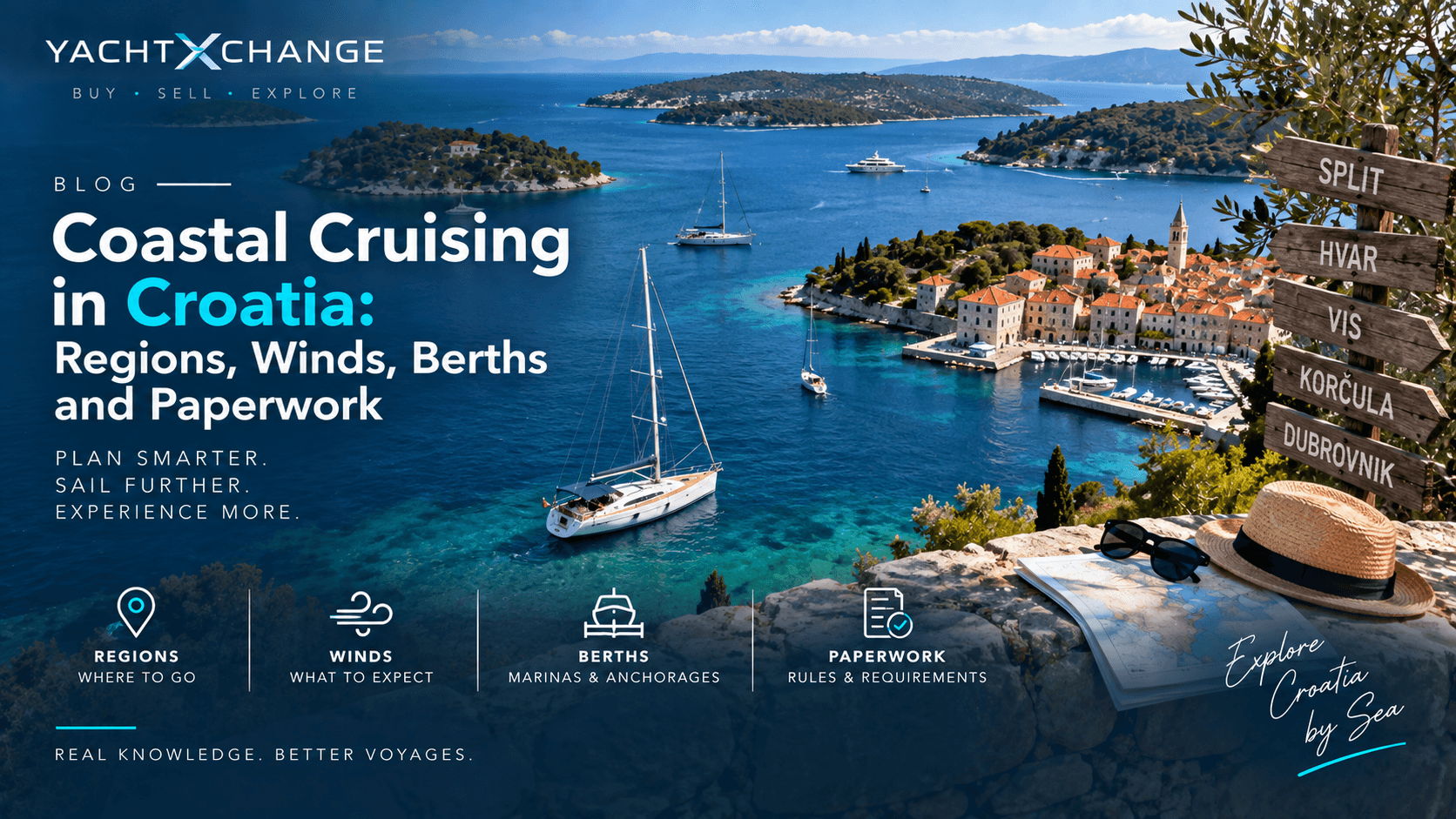
Croatia has become one of the most popular cruising grounds in the Mediterranean, and for good reason. The coast is lined with more than a thousand islands, islets and rocks, most passages between them are short, the water is famously clear, and almost every evening ends in a sheltered bay or a stone-built harbour town. A beginner can cruise here in comfort, and an experienced skipper can spend years without running out of new anchorages.
That popularity also brings crowds, rules and fees that surprise first-time visitors. This guide covers the regions, the winds, where to stop each night and the formalities to arrange first.
Why Croatia works so well
Many days involve 15 to 30 nautical miles, so you can sail in the morning and be settled by late afternoon. The islands run roughly parallel to the mainland, so there is usually a lee close by when the wind turns, and the coast has a dense network of marinas, town quays and fuel stations.
The regions, from north to south
Istria. The peninsula in the north-west has attractive harbour towns such as Poreč, Rovinj and Pula, but its west coast is fairly open, with fewer islands than further south.
Kvarner. The gulf between Istria and the mainland holds Krk, Cres, Lošinj and Rab. Distances are larger here and this is the area most exposed to the bora, so plan with care.
Northern Dalmatia: Zadar archipelago, Kornati and Šibenik. South of Zadar, hundreds of islands spread out towards the open sea. The Kornati, mostly bare limestone, are a national park and feel remote even in summer. Further south, Šibenik gives access to its own archipelago and to the river Krka.
Central Dalmatia: the Split islands. The busiest charter area in Croatia. From Split and Trogir, boats spread out to Šolta, Brač, Hvar and the Pakleni islands, and further out to quieter Vis.
Southern Dalmatia: Korčula to Dubrovnik. Korčula and Lastovo lead south to Mljet, whose western end is a national park, and to the Elaphiti islands just north of Dubrovnik. Lastovo, one of the most remote inhabited islands, is a nature park with its own rules.
The winds: bora, jugo and maestral
Croatian weather is mostly settled in summer, but two winds deserve respect.
- Bora (bura). A cold, dry, north-easterly wind that falls off the mountains in strong, sudden gusts. It can arrive with little warning, often under a clear sky, and is strongest in Kvarner and below high mountains on the mainland. Bays open to the north-east become dangerous quickly.
- Jugo. A warm, humid south-easterly that usually builds over a day or more, bringing cloud, rain and a long, heavy sea, especially in southern and outer waters. Harbours and bays open to the south-east can become uncomfortable or untenable.
- Maestral. The pleasant summer sea breeze from the north-west, usually building around midday and dropping in the evening. It gives most of the good sailing days.
Summer thunderstorms can also bring violent squalls. Check forecasts at least twice a day and always know where you will go if the wind changes overnight.
Where to stop: marinas, town quays, buoys and anchorages
Marinas. The most comfortable and the most expensive option, with water, power, showers and staff to help you moor. Most use lazy lines (bow or stern-to). Many are busy on charter changeover days, usually at the weekend.
Town quays. Many harbour towns let visiting boats moor stern-to on the town quay, often with lazy lines, water and power, for a fee collected by the port authority or a concessionaire. You are in the centre of town, but it can be noisy and exposed to ferry wash.
Mooring buoys. Many popular bays now have buoy fields run by concessionaires, with a fee collected by boat in the evening. Check that the buoy suits your boat's size and do not assume every buoy is well maintained.
Anchorages. Free anchoring is still possible in many places, though in some protected areas or concession zones a fee may apply or anchoring may be restricted. Seagrass meadows are common: anchor on sand where you can, and expect to take a line ashore in tight coves.
Arriving from abroad: clearing in and fees
Croatia is in the European Union and, since 2023, in the Schengen area. If you arrive by sea, especially from outside the Schengen area (from Montenegro, for example), you must go directly to a designated port of entry, where the border police check passports and the harbourmaster's office handles the vessel formalities.
Foreign leisure vessels pay two main charges, managed and recorded through official online systems:
- A navigation safety fee, which depends mainly on the size of the boat.
- A tourist tax for everyone on board, which depends on the number of people and the length of the stay.
You will also need to register your crew list and keep it up to date when people join or leave. The amounts, the payment process and the documents required (registration, insurance, skipper's qualification and radio licence) change from time to time. Check the current rules with the Croatian harbourmaster's office or the official government sources before you leave, and keep all receipts on board: inspections are common.
National parks and protected areas
Some of the best cruising sits inside protected areas, and they charge for entry.
- Kornati National Park requires an entry ticket for every boat, priced by boat size. Tickets can be bought in advance or inside the park, and the price may differ.
- Mljet National Park charges an entry fee for visitors to its western part, including those arriving by boat.
- Nature parks, such as Telašćica next to the Kornati and the Lastovo islands, may also charge fees and set rules for anchoring and mooring.
Ask the park authority or the harbourmaster for current prices and rules, and respect restrictions on anchoring, fishing and speed.
Season and crowding
July and August are the busiest months, with full marinas, crowded anchorages and long queues for fuel. If you can, cruise in June or September: the water is warm and you will find space more easily. May and October are quieter still, with less predictable weather and some services closed.
In peak season, arrive early, book berths ahead and keep a second option for the night.
A sample one-week route from Split
A relaxed loop; adjust it to the weather each day.
- Split to Maslinica (Šolta). A short first leg to settle in, with a quiet harbour for the night.
- Šolta to Vis. A longer, open-water passage to Vis town or a nearby bay.
- Vis to Komiža. A short hop round the island; with calm weather, a morning visit to the caves on Biševo.
- Komiža to the Pakleni islands and Hvar. Anchor or use a buoy in the Pakleni and take the tender to Hvar town.
- Hvar to Korčula. Moor in or near Korčula town and explore the old town.
- Korčula to Brač. One of the longer legs, to Milna or Bol, depending on the wind.
- Brač back to Split. An easy final leg, arriving early to beat the end-of-week rush for fuel and berths.
Start your search
If cruising Croatia makes you want a boat of your own, browse the yachts for sale in Croatia on Yachtxchange, many of them already based on this coast. To plan where to stay and where to keep her, browse the Croatian marinas directory.
This guide is general information. It does not replace official charts, pilot books, notices to mariners, local regulations or good seamanship. Fees and rules change; confirm them with the Croatian authorities before you sail.